
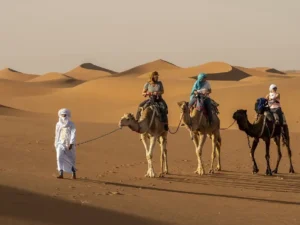
Wondering about the best time to visit Sahara Desert dunes from M’Hamid? Ask ten people who’ve traveled to the Moroccan Sahara and you’ll probably get ten different answers. That’s because there isn’t one single “best” month — it depends on what you actually want out of the trip. Mild trekking weather? Dramatic winter skies for stargazing? The quietest, emptiest desert you can find? Each points you toward a different season.
Quick answer: for most travelers, the best time to visit Sahara Desert camps from M’Hamid is October to November, when days sit between 22–32°C and nights are comfortable. December to February rewards stargazers, March–April offers mild spring conditions, and July–August is only for well-prepared heat-tolerant travelers.
What almost everyone agrees on is this: timing matters more in the Sahara than almost anywhere else in Morocco. The coast stays mild nearly year-round. The desert does not. Temperatures here swing from near-freezing winter nights to summer days that regularly cross 45°C (113°F). Get the timing wrong and a dream trip can turn uncomfortable fast. Get it right, and you’ll understand exactly why people fall in love with this landscape.
This guide walks through the Sahara’s climate month by month, based on conditions around M’Hamid El Ghizlane, the gateway town for the dunes of Erg Chigaga and Erg Zahar — so you can choose the right season for a Sahara desert trekking trip, a family-friendly camel excursion, or a longer multi-day expedition.
Table of Contents
- Why the Sahara’s Climate Is So Extreme
- Best Time to Visit Sahara Desert: Month-by-Month Breakdown
- Sahara Desert Weather at a Glance
- A Note on Spring Winds and Sandstorms
- The Best Time of Day, Regardless of Season
- Matching the Season to Your Trip Length
- Frequently Asked Questions
- Final Thoughts: Choosing Your Season
Why the Sahara’s Climate Is So Extreme
The desert’s dryness is the reason for its wild temperature swings. Without moisture in the air to trap heat, sand heats up fast under direct sun and loses that heat just as fast once the sun drops. A 30°C afternoon in the dunes can become an 8°C night within a few hours — a detail that catches a lot of first-time desert travelers off guard, especially those who assume “desert” simply means “hot.”
This daily swing exists in every season, but its scale changes depending on the month. In winter, days are pleasant and nights are properly cold. In summer, days are punishing and nights are merely warm. Understanding this rhythm is the real key to choosing when to visit — not just picking “summer” or “winter” in the abstract.
Best Time to Visit Sahara Desert: Month-by-Month Breakdown
October and November — The Best Overall Months
If you only remember one recommendation from this guide, make it this: October and November are the best time to visit Sahara Desert dunes from M’Hamid.
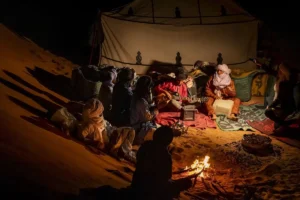
By early October, the brutal summer heat has broken. Daytime temperatures typically settle between 25–32°C — warm enough to feel like the desert, but not so hot that trekking or camel riding becomes exhausting. Nights cool to a comfortable 12–18°C, meaning you can genuinely enjoy an evening around the campfire without needing three layers.
November pushes further into “ideal” territory, with daytime highs easing toward 22–28°C and nights around 8–14°C. The light in these months is also exceptional for photography — softer and warmer than the flat glare of a summer afternoon.
This is peak season for a reason, so if you’re set on October or November, book your tour and camp stay well in advance, particularly around school holiday periods when demand rises sharply.
December, January, and February — Sahara Winter
Winter in the Sahara surprises a lot of first-time visitors. Daytime temperatures are frequently mild and pleasant — often 16–22°C, perfect for hiking dunes without overheating. But once the sun sets, the desert’s dry air offers no insulation, and temperatures can fall to 0–5°C, occasionally colder on exceptionally clear nights in December and January.
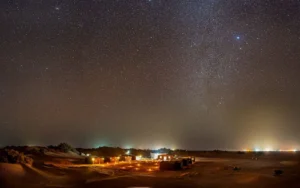
Here’s the thing most people don’t realize until they’ve experienced it: winter is arguably the most magical time to sleep in the Sahara, not the least. Clear winter skies produce some of the best stargazing conditions of the year — no summer haze, no dust, just an uninterrupted view of the Milky Way above the dunes. Winter is also noticeably quieter than October–November, so if solitude matters more to you than warmth, this season deserves serious consideration.
The trade-off is simple: come prepared. A proper sleeping bag rated for near-freezing temperatures, warm layers for the evening, and a hat and gloves for after dark make the difference between a magical night and a miserable one. Our nomad camp near M’Hamid provides extra blankets, but bringing your own thermal layers is still the smartest move.
March and April — Spring in the Desert
Spring brings a gradual warm-up. In March, expect daytime temperatures around 22–28°C with nights near 10–15°C — very close to the comfort of October. By April, days warm further into the high 20s and low 30s, and by late April you’re starting to edge toward pre-summer heat.
If winter rains have fallen (which happens in some years, though not every year), you may catch a rare and beautiful sight: patches of green vegetation across the pre-Sahara landscape, a striking contrast against the sand. Spring is also a good window if you want mild weather but slightly fewer crowds than the October–November peak.
May, June, and September — The Shoulder Season
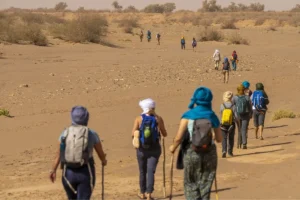
These three months sit in a transitional zone: warmer than spring or autumn, but not yet at full summer intensity. Expect daytime highs in the 32–38°C range, which is manageable with the right rhythm — early starts, a rest period during the hottest midday hours, and activity resumed in the late afternoon and evening.
This rhythm isn’t a modern accommodation for tourists; it’s simply how desert life has worked for centuries. Local nomadic communities have always structured their days around the sun’s intensity, and adopting the same pattern makes these shoulder months entirely workable — even enjoyable — for visitors.
September in particular can be a smart choice if you want summer-adjacent pricing and lighter crowds without the full brunt of July and August heat.
July and August — Peak Summer Heat
July and August are unambiguously the hottest months in the Moroccan Sahara, with daytime temperatures regularly climbing past 40°C and sometimes exceeding 45°C in the exposed dunes. This isn’t a season to rule out entirely, but it does demand real preparation and a realistic itinerary.
Successful summer trips lean heavily on early starts (trekking begins before sunrise), heavy and constant hydration, loose breathable clothing, and activities scheduled around the cooler hours of dawn, dusk, and night rather than the punishing midday sun. Some travelers choose summer specifically for the near-empty desert and lower rates, but this season is best suited to those used to extreme heat, or planning shorter, well-timed desert activities rather than long midday treks.
Sahara Desert Weather at a Glance
| Season | Months | Daytime Temp | Nighttime Temp | Best For |
|---|---|---|---|---|
| Peak comfort | October, November | 22–32°C | 8–18°C | First-time visitors, photography, ideal all-round conditions |
| Winter | December, January, February | 16–22°C | 0–5°C | Stargazing, solitude, budget-conscious travelers who pack warm |
| Spring | March, April | 22–30°C | 10–16°C | Mild weather, slightly fewer crowds than autumn |
| Shoulder heat | May, June, September | 32–38°C | 15–22°C | Travelers comfortable adjusting activity around midday heat |
| Peak summer | July, August | 40–45°C+ | 20–26°C | Experienced desert travelers, short well-timed excursions |
A Note on Spring Winds and Sandstorms
One factor that rarely makes it into weather tables: wind. Late winter and spring (roughly February through April) is when the desert around M’Hamid sees its windiest days, occasionally including sandstorm conditions driven by the hot, dry chergui wind blowing in from the east.
Most days are perfectly calm, and a windy afternoon is more of an inconvenience than a danger — a scarf or chèche (the traditional desert head wrap) handles blowing sand comfortably, and camps are designed around it. But if you’re planning a photography-focused trip or traveling with young children, it’s worth knowing that autumn generally offers calmer air than spring, even though daytime temperatures in both seasons are similar. If a serious sandstorm is forecast, local guides simply adjust the day’s plan — another reason traveling with an experienced local tour operator matters more here than almost anywhere else in Morocco.
The Best Time of Day, Regardless of Season
No matter which month you choose, the golden rule of desert travel stays the same: sunrise and sunset are the best times to be out on the dunes. This is when the light turns the sand gold, red, and orange; when temperatures are at their most pleasant; and when photographs turn from “nice” to genuinely unforgettable. Midday — even in the milder months — is generally reserved for resting in the shade of camp, exactly as it has been for generations of desert nomads.
Matching the Season to Your Trip Length
The season you choose can also shape how long you’ll want to spend in the desert. In the mild months (October–April), longer multi-day treks are far more comfortable, since you’re not racing to avoid the harshest hours of heat. In peak summer, shorter, well-timed excursions often make more sense than multi-day treks unless you’re specifically prepared for the conditions.
Our tours page lists everything from a single-day excursion to five-day treks, so once you’ve settled on a season, you can match it to a trip length that fits both your comfort level and your schedule. If you’re unsure how many days you need, our plan your Sahara experience page breaks down exactly how to build an itinerary around your available time and the season you’re traveling in.
And whatever month you land on, it’s worth reading through our complete Sahara Desert packing list before you go — what you pack changes quite a bit depending on the season.
Frequently Asked Questions
What is the best time to visit Sahara Desert dunes from M’Hamid?
October and November offer the best overall balance: warm 22–32°C days, comfortable nights, and exceptional light for photography. March and April are a close second, while December–February suits travelers who prioritize stargazing and solitude over warmth.
Is the Sahara Desert cold at night?
Yes — even in the hottest months, desert nights are noticeably cooler than daytime highs. In winter (December–February), nights can approach freezing, so warm layers and a proper sleeping bag are essential regardless of when you visit.
What is the coldest month in the Sahara near M’Hamid?
January is typically the coldest month, with daytime temperatures around 16–20°C and nighttime lows sometimes reaching 0–5°C.
Can you visit the Sahara Desert in summer?
Yes, but it requires preparation. Daytime temperatures in July and August regularly exceed 40°C, so summer trips work best with early starts, heavy hydration, and activities scheduled around the cooler hours of morning and evening.
What should I pack for a Sahara Desert trip?
Regardless of season, pack layers: breathable, loose clothing for the day and a warm layer plus a hat for the evening. In winter, add a proper warm sleeping bag and gloves. Sun protection — a wide-brimmed hat, sunglasses, and high-SPF sunscreen — is essential year-round. Our full packing list covers everything in detail.
For more detailed planning questions, our FAQ page covers everything from what to bring to what to expect at camp.
Final Thoughts: Choosing Your Season
There’s no single “wrong” month, but if you’re still weighing options, here’s the honest summary of the best time to visit Sahara Desert camps: if comfort and ease are your top priorities, October and November are your safest bet. If you’re chasing dramatic winter stargazing and don’t mind the cold after dark, December through February rewards well-prepared travelers with a quieter, more atmospheric desert. And if you’re traveling in the warmer months, a little planning around the day’s rhythm goes a long way.
Whatever month you choose, waking up to sunrise over the dunes from a Sahara desert camp near M’Hamid is an experience that stays with you long after the trip ends.
Continue Reading
- How to Reach M’Hamid El Ghizlane from Marrakech, Fez & Ouarzazate
- Erg Chigaga vs Erg Chebbi: Which Sahara Dunes Should You Visit?
- Camel Trekking in the Sahara: What to Really Expect
Ready to plan your trip around the right season? Contact us or message us directly on WhatsApp at +212 621 440 716 — we’ll help you time your visit perfectly.